
Full Vertical Domestic Manufacturer of Optics
NASDAQ Ticker: LPTH
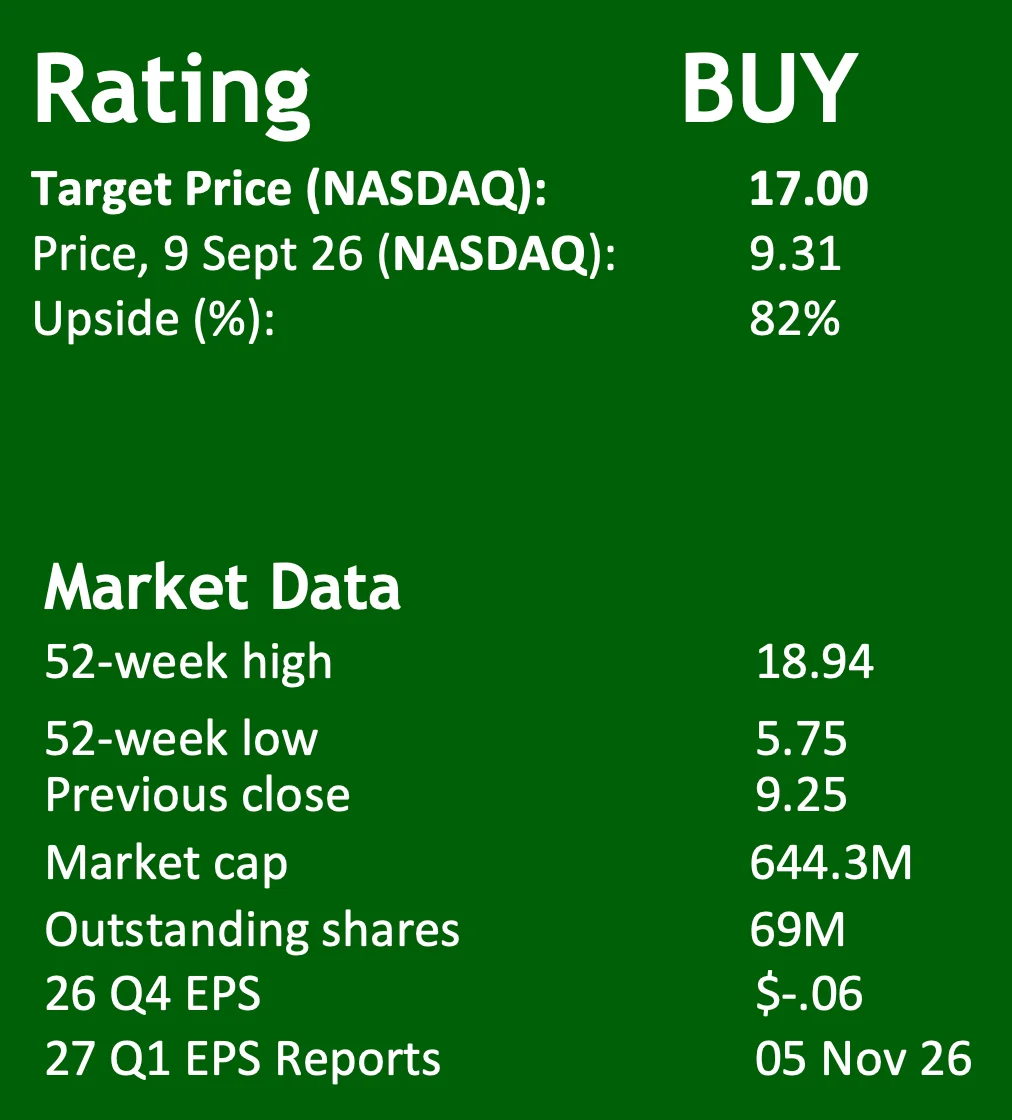
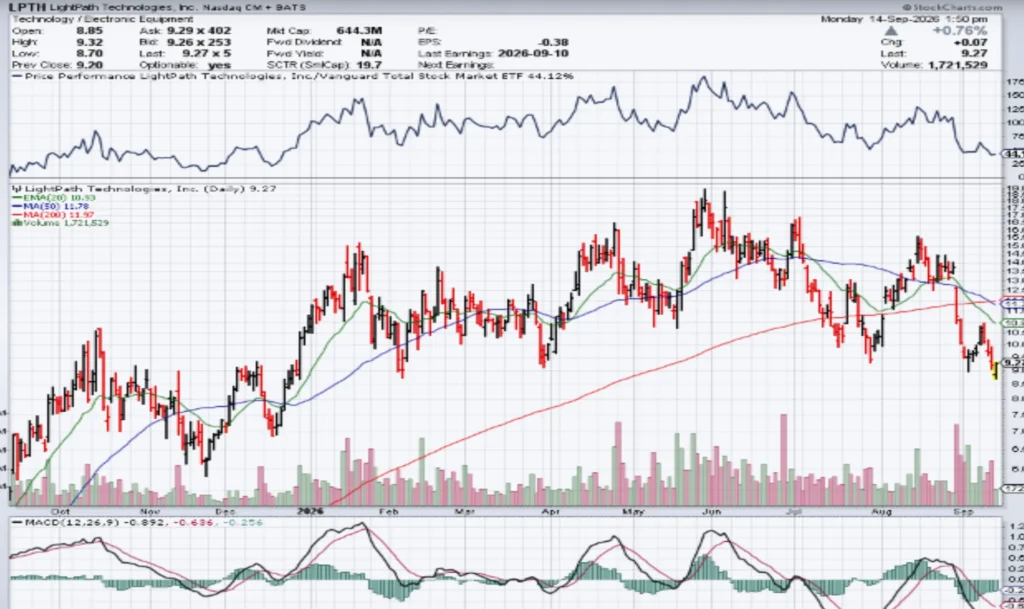
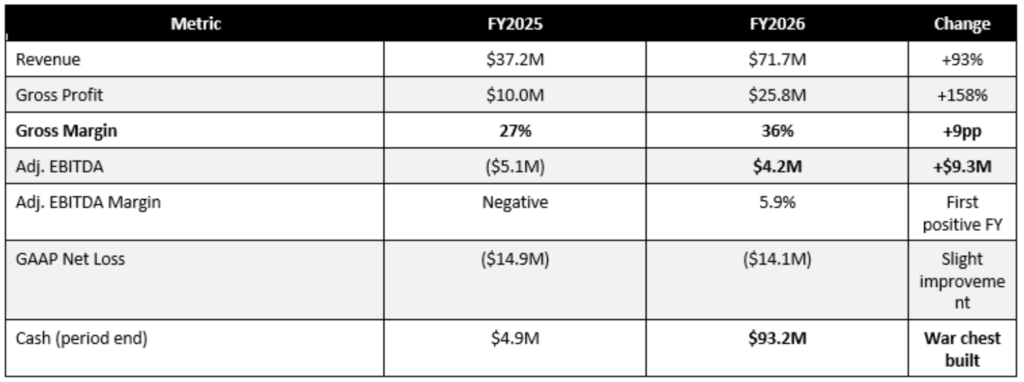
This initiation carries a BUY rating for LPTH on the strong tailwinds it is receiving from increased U.S. defense spending, a growing industry pipeline, replenishment of missiles, and management’s renewed focus on long-term contract wins and the NDAA FY30 requirement for defense companies to utilize supply chains domestic to the US. LPTH maintains a strong liquidity position with ample cash and virtually no debt to sustain its growing expansion plan. The company’s current valuation is also appealing, with an EV/Sales FWD multiple of 5.27, which is higher than the sector median of 3.73, a premium that’s justified by revenue growth of 93% YoY, ending FY26 at $71.7M.
The NDAA-FY30 Deadline is Approaching Now.
U.S. National Defense Authorization Act (NDAA) Section 834 forces the entire U.S. defense supply chain to replace Chinese-sourced optical glass with domestic alternatives by Jan 1, 2030. LightPath is the only domestic supplier with a proprietary glass technology, licensed exclusively from the U.S. Naval Research Laboratory, that cannot be replicated. Germanium alternatives are emerging at a slower rate and have limited global production, reinforcing LPTH’s first-mover advantage as a beneficiary of this mandate.
The 2030 Procurement Wave Shows in Backlog, Margins & More
Defense programs that want to be compliant by Jan 1, 2030 must lock in optical suppliers by 2027 at the latest for 18-24 months of integration, testing, and qualification. The procurement decision window is now. The Q4 backlog of 110.9M is up 197% from the end of last year, with gross margins expanding from 27% to 36% and Adjusted EBITDA moving from negative $5.1M to Positive $4.2M
Business Description
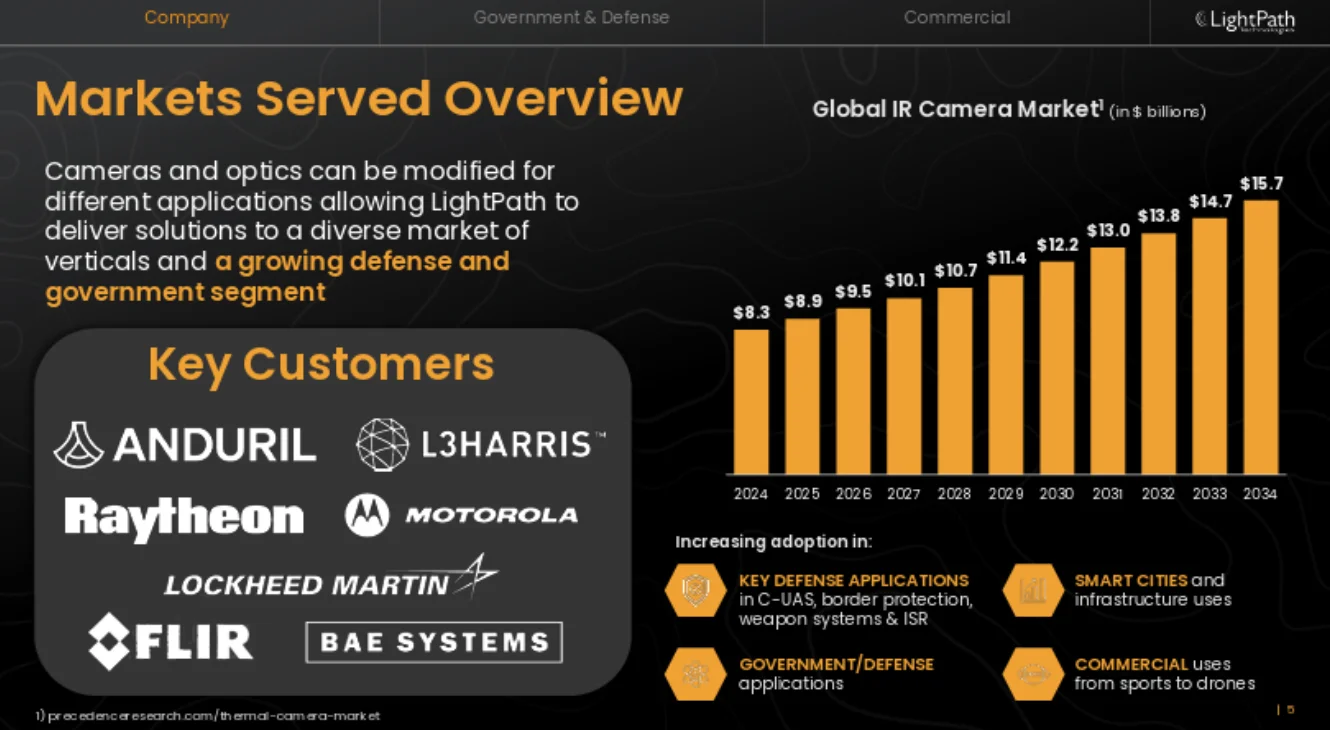
LPTH, headquartered in Orlando, FL, is the only vertically integrated, NDAA-compliant domestic manufacturer of infrared optical glass, assemblies, and camera systems in the United States. They also have additional manufacturing and development facilities in New Hampshire, Texas, and Latvia, and as of recently in mid-2026, they divested their legacy manufacturing operation in China. Having transitioned from a manufacturer of visible-light optical components, the company is now a vertically integrated supplier of high-value infrared optical components, complete camera systems, assemblies, and engineering services. Its product lines address markets such as defense, border and perimeter security, night vision, medical devices, industrial inspections, and more. The company has completed a three-year transformation, making roughly $9M per quarter, compared with a defense system supplier doing $21M per quarter, with gross margins expanding by 900 basis points, $110.9M in backlog revenue, and $93M available in cash for expanding production, with only $10M in debt obligations.
Optics & Assemblies
- Building on unique BackDiamond materials to provide an alternative to germanium.
- Optical systems and subsystems for infrared imaging.
- Total addressable market (“TAM”) of $500M to $1B.
Infrared Camera Systems
- Leverages tech from acquisitions, together with unique capabilities from BlackDiamond.
- Building on recently acquired G5’s leadership in long range imaging.
- TAM of $1B to $1.5B.
Large Defense Programs
- U.S. Defense programs with substantial, sponsored engineering fees.
- Potential for tens of millions in annual revenue for each program.
- Leverages LightPath’s core capabilities in infrared optics and imaging to develop customized solutions for programs of record.
Macro Trends: Drone & Program Opportunities
Drones and significant Programs of Record are major catalysts that the market is discounting; LPTH will win. With ONDAS Holdings and Unusual Machines (UMAC), leading domestic drone manufacturers that have made strategic equity investments in LPTH, these represent recurring, durable revenue opportunities within expanding total addressable markets. Of the $110.9M Backlog, Counter-UAS is ~43M of the backlog, primarily from the Air Force SUADS programs, with optics for drones and assemblies. Missile Seeker programs such as the Next Generation Short Range Interceptor are a replacement for the aging Stinger missiles with LPTH as the sole-source infrared imager, which could unlock ~$50M-100M in annual recurring revenue.
Border & Space Not in the Backlog Yet
LPTH is currently involved in six active Programs of Record with talks of space satellites among three customers. This explains that these are not just one-time contracts, but consistent revenue that will be large for the company.
Multiple conversations have begun for LPTH to supply the optics for space satellites, which will be another TAM for LPTH to enter. With the recent Acquisition of AMI in Jan. 2026, LPTH could melt BlackDiamond Chalcogenide glass (their proprietary glass licensed by U.S. NRL) only up to 5 inches in diameter. This acquisition now allows them to melt up to 10 inches and the ability to go larger, as well as doubling their manufacturing capacity. This is not incremental improvement; it’s categorical expansion.
Department of Homeland Security has not flowed through as of Q4. The Q4 earnings transcript states that “Border Patrol is not yet a large contributor because DHS funding has not flowed through to LightPath.” This represents a definite future catalyst that has not yet materialized in the reported backlog.
Backlog: The Demand Signal
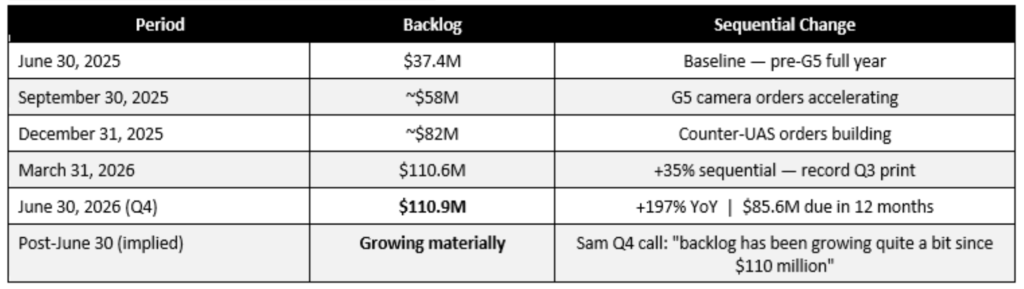
Backlog Five Consecutive Quarters of Growth
The backlog has grown for five consecutive quarters without a single decline. Of the $110.9 million total, $85.6 million is requested for delivery within 12 months, representing committed purchase orders with stated delivery dates from named defense and government customers. The $110.M backlog was almost entirely built before the large-diameter BlackDiamond step function materialized. The AMI acquisition, which allows them to melt glass up to 10+ inches, which allows new long-range assemblies utilizing this capability are still being developed.
The Profitability Trajectory
The G5 Infrared Acquisition of February 2025
G5 Infrared was a small privately held company in New Hampshire founded by defense optics veterans. G5 built a specific category of product: high-end, long-range cooled infrared camera systems. The kind used for surveillances, (ie watching a 20-mile perimeter around a naval vessel or border security). Previously, LPTH already made the most critical components inside every infrared camera: the optical glass and lenses. If they owned the camera itself, they would move from selling a lens at $500 to selling a camera at $50,000. The acquisition closed in February 2025. The details weren’t disclosed, but they included an earnout, meaning that additional consideration would be paid to G5’s founders based on G5’s post-acquisition revenue performance.
The GAAP net loss of $14.1 million in FY26 is almost entirely explained by two non-cash items unrelated to operating performance. Under GAAP, this earnout liability must be marked to fair value each quarter. When G5 outperforms its acquisition targets — which it has, consistently — the earnout liability increases, and that increase flows through the P&L as an operating expense. This is an accounting artifact of acquisition success. It does not reflect cash consumption beyond the actual earnout payment.
Adjusted EBITDA — which strips these non-cash earnout adjustments along with stock compensation and depreciation — is the correct lens for operating performance. FY2026 adjusted EBITDA of $4.2 million represents the first full-year positive figure in the company’s recent history, and the trajectory is clear: Q1 $0.8M, Q2 $0.9M, Q3 $1.1M, Q4 $2.1M. Each quarter is larger than the last.
Analyst consensus previously expected GAAP profitability in FY2027. The updated consensus now expects a small GAAP net loss in FY2027 of approximately $300K as earnout adjustments continue. GAAP profitability at the net income line is likely a FY2028 event. Investors who anchor to GAAP EPS will miss the operating reality entirely.
Risks
Customer Concentration: Motorola Solutions & the Risk Mitigation in Place
This is the single largest idiosyncratic risk in the LightPath investment. Motorola Solutions is almost certainly the unnamed “leading global technology customer” behind the $18.2M CY2026 order, the $11M July 2026 follow-on, and the $22M anticipated CY2027 framework tranche. If these three flow as expected, Motorola could represent $40 to $50 million of FY2027’s $106.9 million consensus revenue — approaching 40-50% customer concentration.
Ryan Workman was hired specifically to manage this relationship. The $22M CY2027 tranche is memorialized in a written agreement. Qualifying an alternative IR camera supplier against NDAA compliance requirements takes 18 to 36 months minimum — Motorola cannot switch overnight even if it wanted to. The BlackDiamond camera redesign, when complete, makes LPTH the only domestic supplier able to produce NDAA-compliant cameras at Motorola’s required scale.
The bear case: Motorola is a large, sophisticated company with procurement leverage and multiple supplier relationships. If DHS counter-UAS program funding is reduced, if Motorola’s government contracts are rescoped, or if Motorola decides to vertically integrate its own camera supply, LightPath loses 40-50% of its forward revenue in one decision. This concentration risk cannot be minimized — it must be sized and monitored.
G5 Camera Redesign Delay
The BlackDiamond redesign of G5’s larger camera models — the ones that represent the majority of G5’s revenue by dollar value- is running behind schedule. Sam disclosed two specific reasons on the Q4 call: supply chain strain on the detector side (detectors are a separate component from the glass, and detector lead times have extended globally), and the fact that AMI has never previously melted chalcogenide glass at the sizes required for G5’s large cameras. Sam noted that even LightPath took three years from licensing the NRL materials to producing them at commercial quality; AMI is moving faster, but this is first-article work.
The delay is a timing risk, not a technical impossibility. The germanium-based G5 cameras continue shipping; the $11M July follow-on order is for germanium cameras. The BlackDiamond redesign is additive upside when it arrives. The risk is that the “step function” demand growth that management has been telegraphing does not show up in FY2027 H1 as investors expect, pushing the catalyst into H2 or FY2028.
Glass Production Capacity Constraint
Sam has said repeatedly that demand for BlackDiamond glass outstrips supply even after doubling capacity with the AMI acquisition. FY2027 CapEx is aimed primarily at this bottleneck. But glass melting equipment has long lead times, commissioning requires qualification runs, and first-article glass at new sizes requires fine-tuning. Any slippage in the capacity build delays delivery against the $85.6M near-term backlog and constrains new order intake. Glass capacity is simultaneously the company’s biggest competitive advantage and its biggest operational constraint.